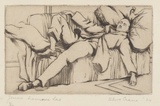
Olive Crane, Jeune homme las [weary young man]. 1924
Title
Olive Crane, Jeune homme las [weary young man]. 1924
Author
Batchen, Geoffrey.Details
14 October 2026Type
About the work
Language
EnglishCountry of context
Australia
Full text
My grandfather, Geoff Hinder (after whom I was named) was a formidable and very formal old man, not comfortable with children, and I was always a little scared of him. I slept in a bed (under mosquito nets) in his study, surrounded by framed photographs of his earlier years. He was a fanatical Kings old boy, and a keen sportsman (he was the best body surfer I ever saw, even late in life when he was a bit rotund) and sports follower. I’m sure I disappointed him on all sorts of levels. He was very involved in the Queensland Rugby Union (a Vice-President) and worked hard on preparing the new international ground, Ballymore (I remember seeing him, stripped to the waist and gleaming with sweat, mowing the lawn on the practice field). When he died, many years later, a minute of silence was observed at Ballymore.
I recently discovered another side to Geoff Hinder. I was invited to give the keynote address at a conference in Canberra and flew over from New York for that purpose. On July 8, 2008, I arrived to have dinner at the home of Helen Ennis and Roger Butler. Roger was curator of Australian prints and drawings at the National Gallery of Australia and had just published the first two volumes of his history of Australian print making. I was flipping through them while waiting for dinner. All of a sudden I came across an image I recognized. It was an engraving by an Australian artist named Olive Crane, made in 1924 in London or Paris and titled (in French) Jeune Homme Bas (Weary Young Man). It shows such a man lying on a couch with his head propped up on a large pillow and his clothing in a state of disarray. “What do you know about this print, Roger?” I asked. He told me it was the only copy of it that he had seen and that it was a very unusual image in the history of Australian print making. He then made a joke about how the young man was obviously having an affair with the artist, given his post-coital attitude of casual abandonment. “That’s funny,” I said, “because only this morning my mother pointed to this print on the wall at home and told me ‘that’s my father’.” Much conversation ensued.
Mum confirmed that Geoff Hinder was in London in 1924, having just failed medicine at Sydney University. He had gone over to Bradford in northern England to learn the wool trade. Like the young man in the print, he wore wire-rim glasses and had a pencil-thin mustache (gone when I knew him). Mum said he had never mentioned Olive Crane to her (Crane died in 1935) but had kept that print in his study all of his life and that she had inherited it from him after he died. She thought friends must have given it to him because it just coincidently looked like him. Later, my father took me for a walk and confided that he and Geoff had driven down from Brisbane to Sydney to pick up Gillian after she arrived home from London in 1955. On the way, Geoff had confessed to David, in a moment of uncharacteristic candor, that he had seduced a married woman and was having sex with her as his ship entered the heads to Sydney Harbour on the way back from London in 1924. Dad tells me he was shocked. Geoff Hinder married my grandmother, Etta Day, the following year and presumably lived happily ever after. Just shows, you never can tell a book from its cover.
[© Geoffrey Batchen, 14 October 2026]
Last Updated
14 Oct 2026